
Cleaning up a marketplace catalog before adding more products
How we would audit and repair listings for a seller on Amazon and eBay whose catalog grew faster than its product data.

The situation
Imagine a home goods seller with listings on Amazon and eBay. Listings were added quickly over two years by different people. Titles follow no pattern, some photos break marketplace rules, and stock is updated by hand on each account, so items sometimes sell after they have run out.
What gets in the way
- Titles and descriptions follow no common pattern
- Some images and details do not meet current marketplace rules
- Stock is updated by hand on each marketplace
- Buyers ask questions the listings should already answer
What the system should achieve
- 01One product sheet as the single source for every listing
- 02Titles, attributes and images that follow each marketplace's rules
- 03A stock routine that keeps both marketplaces in step
- 04Fewer repeated buyer questions
How we would work through it
Each step has an output the owner can check before the next begins.
- 01
Audit the catalog
Export every listing and mark missing details, rule problems, duplicates and stock mismatches.
An audit sheet with issues per listing - 02
Build the product sheet
Create one sheet with agreed names, attributes, sizes and stock for every product.
A single source product sheet - 03
Repair in batches
Rewrite titles and details, replace images that break the rules and fix categories, starting with the best sellers.
Listings repaired in priority order - 04
Set a stock routine
Agree how stock is updated on both marketplaces, either as a daily routine or with a tool scoped separately.
A written stock routine - 05
Review monthly
Check returns, questions and suppressed listings each month and fix the causes.
A monthly review checklist
What we would put in place
The work would be listing management and catalog cleanup within each marketplace's rules. Rankings and sales are not promised; they depend on the product, price, competition and the marketplace itself.
- Catalog auditIncluded in the service
- Single product sheetIncluded in the service
- Listing repairs on Amazon and eBayIncluded in the service
- Stock update routineIncluded in the service
- Automatic stock sync toolScoped separately in writing
Building blocks
Indicative only. Final choices are made after discovery and confirmed in the written scope.
What it could look like
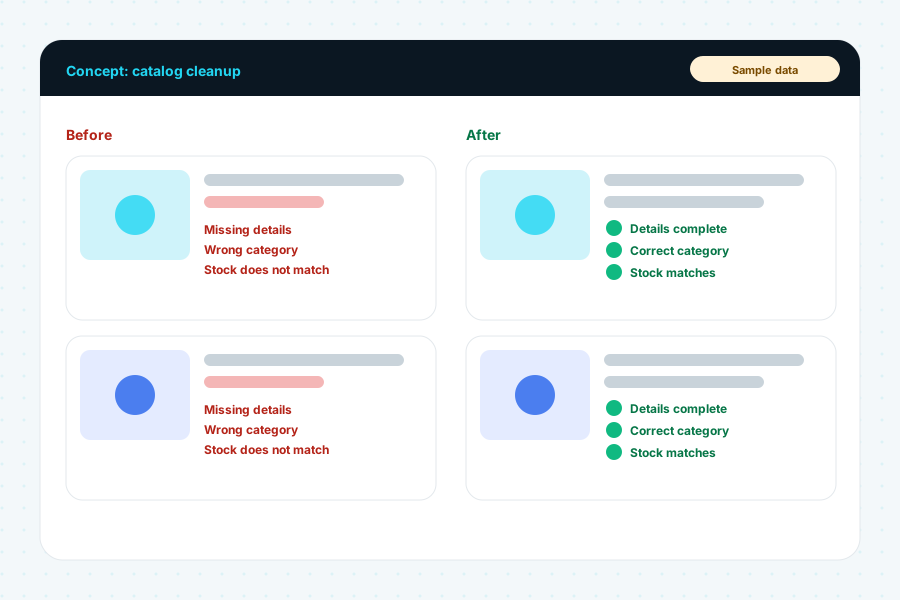
Example screens with sample data.
Included in the service
- Catalog audit
- Single product sheet
- Listing repairs on Amazon and eBay
- Stock update routine
Scoped separately in writing
- Automatic stock sync tool
Built from
- A shared product sheet as the source of truth
- Marketplace bulk upload files
- A stock sync tool, only if scoped
How success is judged
Every project starts by recording the business's own figures, so improvement can be measured against them rather than assumed.
Before and after
Success would be checked against the business's own figures, recorded before the work starts:
- Listings with missing or rule-breaking details
- Orders canceled because of stock mismatches
- Repeated buyer questions per week
- Returns by listing
More solution examples

Launching a Shopify store for a brand that sells through Instagram
How we would move a small clothing brand from direct-message orders to a Shopify store with clear products, payments and delivery.
Shopify Store Development, Ecommerce DevelopmentRead the example →
One system for a mart's sales and stock
How we would bring billing, stock and a daily sales record for a two-counter mart into one system.
POS, Inventory and ERP Solutions, Custom Software DevelopmentRead the example →
Order-to-kitchen flow for a busy café
How we would carry orders from the counter to the kitchen and into day-end totals without handwritten slips.
POS, Inventory and ERP Solutions, Website Design and DevelopmentRead the example →Facing something similar?
Tell us how your business works today. We will adapt the approach and send a private proposal.