
One system for a mart's sales and stock
How we would bring billing, stock and a daily sales record for a two-counter mart into one system.
The situation
Imagine a neighborhood mart with two counters and a stockroom. Sales are added up on a calculator and written in a notebook. Stock is entered in a register when deliveries arrive. The owner counts the cash at night, but only learns what is left on the shelves when something runs out.
What gets in the way
- Stock in the register rarely matches the shelves
- The same item appears under two or three names
- Closing the day means adding up two notebooks
- The owner cannot see what sold best without hours of work
What the system should achieve
- 01Every sale billed at the counter and recorded once
- 02Stock that goes down as items sell and up as deliveries arrive
- 03One clean product list with agreed names and prices
- 04A sales history the owner can check each day
How we would work through it
Each step has an output the owner can check before the next begins.
- 01
Watch the counters
Spend time at both counters during a busy hour to see how items are found, priced, discounted and returned.
Notes on real counter habits - 02
Clean the product list
Turn the register into one list with agreed names, prices and units, and remove duplicates.
A product list ready to import - 03
Count opening stock
Count the shelves and stockroom so the system starts from a true number, not last month's register.
Opening stock figures - 04
Pilot on one counter
Set up billing on one counter first and run it beside the notebook for an agreed period, comparing totals daily.
A pilot with daily comparisons - 05
Roll out and review
Move the second counter across, train staff at the counter and read the first weekly report with the owner.
Both counters live, owner reading reports
What we would put in place
The core would be Nexify POS, which covers billing, stock and sales history. Anything the mart needs beyond those three would be listed separately and agreed in writing before work begins.
- Billing at both countersNexify POS core
- Stock that changes with each sale and deliveryNexify POS core
- Sales history for each dayNexify POS core
- Balances for regular customers who buy on accountScoped separately in writing
- Barcode scanning and receipt printing with chosen hardwareScoped separately in writing
Building blocks
Indicative only. Final choices are made after discovery and confirmed in the written scope.
What it could look like
Example screens with sample data.
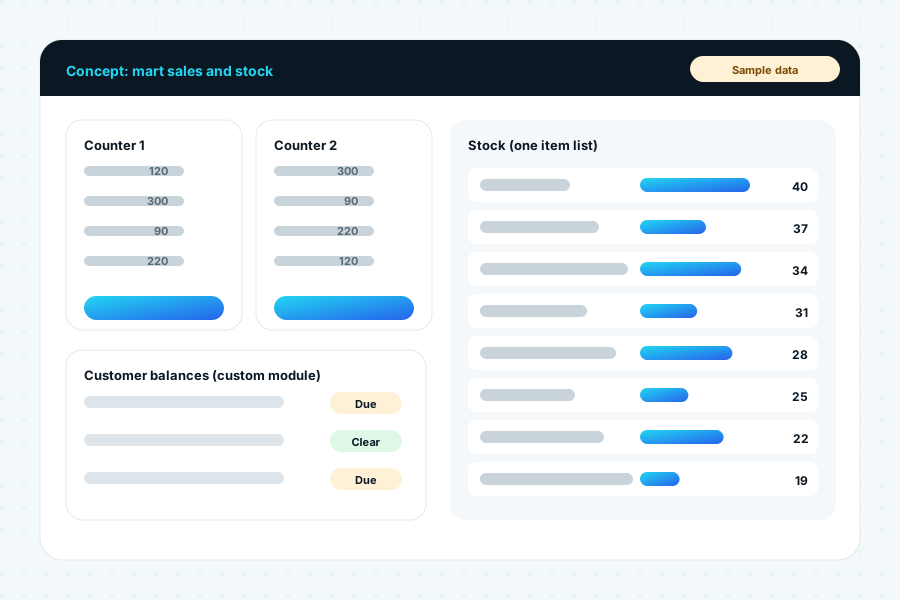
Nexify POS core
- Billing at both counters
- Stock that changes with each sale and delivery
- Sales history for each day
Scoped separately in writing
- Balances for regular customers who buy on account
- Barcode scanning and receipt printing with chosen hardware
Built from
- Product list imported from the existing register
- Counter computers or tablets chosen with the owner
- Custom modules only where agreed in writing
How success is judged
Every project starts by recording the business's own figures, so improvement can be measured against them rather than assumed.
Before and after
Success would be checked against the business's own figures, recorded before the work starts:
- Difference between system stock and a physical count
- Time needed to close the day
- Time to bill a typical customer
- Items found under duplicate names
More solution examples

Order-to-kitchen flow for a busy café
How we would carry orders from the counter to the kitchen and into day-end totals without handwritten slips.
POS, Inventory and ERP Solutions, Website Design and DevelopmentRead the example →
Fee and attendance management for a small school
How we would replace paper registers with one record for fees, attendance and report cards.
School Management Systems, AI Integration and AutomationRead the example →
Launching a Shopify store for a brand that sells through Instagram
How we would move a small clothing brand from direct-message orders to a Shopify store with clear products, payments and delivery.
Shopify Store Development, Ecommerce DevelopmentRead the example →Facing something similar?
Tell us how your business works today. We will adapt the approach and send a private proposal.